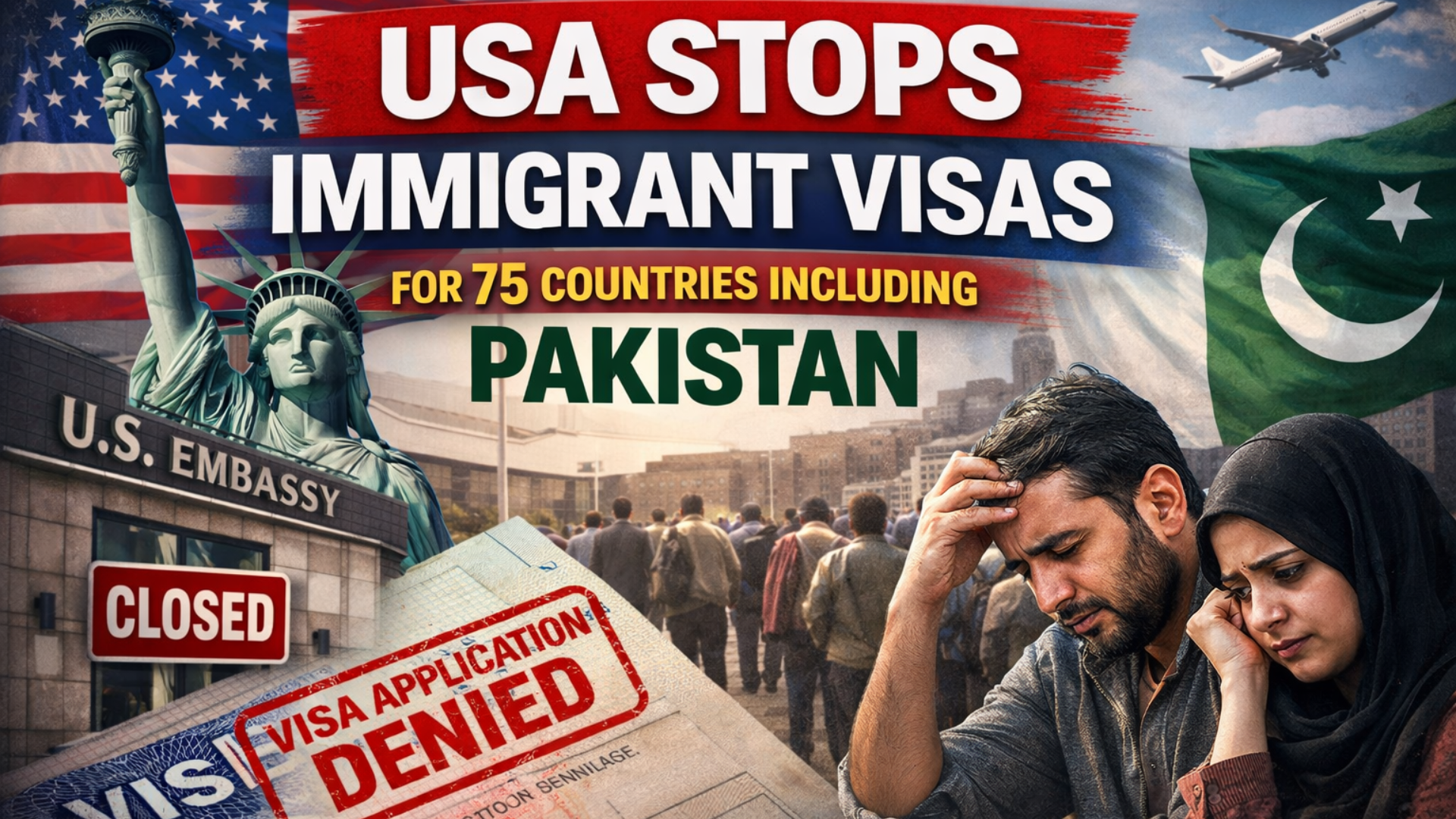
USA Stops Immigrant Visas for 75 Countries. The United States of America has announced a major immigration policy shift, placing an indefinite suspension on immigrant visa processing for citizens of 75 countries, including Pakistan.
The decision, confirmed through an internal directive issued by the US State Department, has already sent shockwaves through immigrant communities worldwide. The suspension is set to take effect from January 21, 2026, and will remain in force until further notice.
This move represents one of the most wide-ranging immigration freezes in recent years and directly impacts thousands of families who were preparing to settle permanently in the United States.
Why Has the USA Suspended Immigrant Visas?
According to the internal State Department guidance, consular officers at US embassies and consulates worldwide have been instructed to pause the issuance of immigrant visas while Washington carries out a comprehensive review of its screening and vetting procedures.
The reassessment focuses on identifying applicants who may become dependent on US government assistance after entering the country. Until updated criteria are finalized, officers have been directed to use existing legal refusal provisions to deny applications that raise financial or medical concerns.
This means that even applicants who meet traditional eligibility standards may now face rejection if they are perceived as a potential public charge.

Key Details of the Immigrant Visa Freeze
Here is what applicants need to know:
- The suspension applies only to immigrant visas, not non-immigrant visas like tourist or student visas.
- The policy affects 75 countries across Asia, Africa, Europe, the Caribbean, and Latin America.
- Visa refusals will be issued under current legal frameworks until new screening rules are approved.
- There is no official end date for the suspension.
Immigration experts say the lack of a timeline adds uncertainty for families waiting on reunification and employment-based immigration.
Pakistan Among the Affected Countries
Pakistan’s inclusion in the list has raised serious concerns, especially for:
- Family-sponsored immigrants
- Employment-based green card applicants
- Diversity visa selectees
Pakistani applicants already face long processing delays, and this freeze is expected to further slow down immigration pathways.
Many families who had completed interviews or were waiting for final approvals now fear indefinite postponement.

Full List of Countries With Suspended Immigrant Visas
The suspension affects citizens from the following countries:
Afghanistan, Albania, Algeria, Antigua and Barbuda, Armenia, Azerbaijan, Bahamas, Bangladesh, Barbados, Belarus, Belize, Bhutan, Bosnia, Brazil, Burma, Cambodia, Cameroon, Cape Verde, Colombia, Cote d’Ivoire, Cuba, Democratic Republic of Congo, Dominica, Egypt, Eritrea, Ethiopia, Fiji, Gambia, Georgia, Ghana, Grenada, Guatemala, Guinea, Haiti, Iran, Iraq, Jamaica, Jordan, Kazakhstan, Kosovo, Kuwait, Kyrgyzstan, Laos, Lebanon, Liberia, Libya, Macedonia, Moldova, Mongolia, Montenegro, Morocco, Nepal, Nicaragua, Nigeria, Pakistan, Republic of the Congo, Russia, Rwanda, Saint Kitts and Nevis, Saint Lucia, Saint Vincent and the Grenadines, Senegal, Sierra Leone, Somalia, South Sudan, Sudan, Syria, Tanzania, Thailand, Togo, Tunisia, Uganda, Uruguay, Uzbekistan, Yemen.
Stricter Screening and Vetting Criteria Explained
A confidential memo circulated to US diplomatic missions in November 2025 outlined expanded screening standards that visa officers must now apply.
Under these new guidelines, officers are instructed to evaluate a broad range of personal and economic factors, including:
- Applicant’s age
- Overall health condition
- Financial stability and income sources
- English language proficiency
- Employment skills and job prospects
- Likelihood of long-term medical care needs
- History of public assistance or institutional care
Applicants who are elderly, have chronic illnesses, or possess limited financial resources are now considered high-risk under the revised assessment approach.

Who Is Most Likely to Be Affected?
Based on the memo, the following applicants face a higher chance of refusal:
- Elderly applicants without strong financial sponsors
- Individuals with chronic medical conditions
- Applicants with limited work history or low income
- Those who previously relied on government aid
- Applicants lacking English proficiency
Even lawful family-based cases may be denied if officers believe the applicant could become a financial burden on the US system.
Official US Government Response
Responding to criticism, Tommy Piggott, spokesperson for the US State Department, defended the decision.
He stated that the department is acting within its legal authority to ensure that immigrants entering the country do not place undue strain on public resources. According to him, the policy aims to protect American taxpayers while maintaining the integrity of the immigration system.
Are Non-Immigrant Visas Also Suspended?
No. As of now:
- Tourist visas (B-1/B-2)
- Student visas (F-1, M-1)
- Exchange visas (J-1)
are not included in this suspension. However, experts warn that stricter questioning and documentation requirements could still apply at visa interviews.
What Should Affected Applicants Do Now?
Immigration advisors recommend the following steps:
- Avoid unnecessary travel for immigrant visa interviews until official updates are released.
- Monitor embassy announcements closely for country-specific instructions.
- Ensure all financial documents are complete and verifiable.
- Seek advice from licensed immigration attorneys for complex cases.
- Do not submit multiple applications, as this may raise red flags.
Global Reaction and Concerns
Human rights groups and immigrant advocacy organizations have criticized the move, calling it overly broad and discriminatory. They argue that economic profiling could unfairly penalize vulnerable applicants, including refugees and family-sponsored immigrants.
On the other hand, supporters of the policy say it strengthens national interests and ensures immigrants are financially self-sufficient.
Could the Suspension Be Lifted?
The State Department has not provided a timeline. Officials say the freeze will remain until the vetting review is complete and new evaluation criteria are officially adopted.
Historically, similar suspensions have lasted several months to over a year, depending on political priorities and administrative changes.
Conclusion
The United States’ decision to halt immigrant visa processing for 75 countries, including Pakistan, marks a significant shift in immigration policy. With stricter screening focused on financial independence and health factors, many applicants now face increased uncertainty.
For families and workers hoping to build a future in the US, the coming months will be critical. Until clarity emerges, staying informed through official channels and preparing strong financial documentation remains the best course of action.